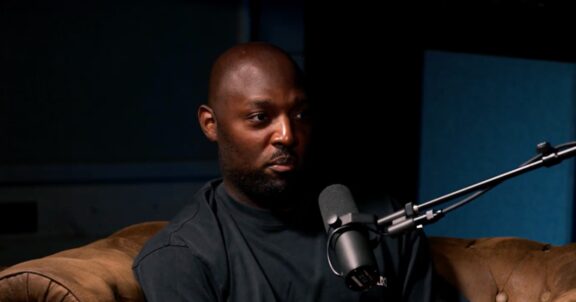

Season 2 · Episode 12
From South London to OBE. BBC 1Xtra Head of Music who backed Stormzy before the world caught up. The Spotify editor who helped build one of the world's most powerful music discovery platforms from a start-up with Gmail accounts. President of Black Music and EVP at Atlantic Records UK, where he helped magnify the careers of Cardi B, Burna Boy and Jack Harlow. Now an investor and co-founder of Titan Publishing - a joint venture with AMM, administered by Kobalt, twenty years in, and Austin Daboh is just getting started.
Austin Daboh OBE is one of the most significant figures in the modern UK music industry. He began his career as a media monitoring executive at Durrants - where reading about the BBC all day, every day, prepared him for a job interview question about the German election that changed everything - before joining the BBC as a media planner for Radio 4 and Radio 5 Live, and then moving to BBC 1Xtra as Music Coordinator, effectively second in command of the music team.
He rose to Head of Music at 1Xtra during a period he describes as ripping up the rulebook - championing a generation of Black music superstars including Stormzy, Dave and AJ Tracey, and becoming the first person in the media industry to playlist Ed Sheeran before anyone else had decided he was going to be a superstar. He left the BBC for a period to run The Hub Entertainment, a management and branding agency that worked with BBC presenters, music artists and two athletes who won medals at the London 2012 Olympics, before returning to 1Xtra as Head of Music. He was then recruited to Spotify by George Ergatoudis - who had been his boss at the BBC - joining a London office of around 75 people still running on Gmail, at a moment when the absence of red tape and the depth of pre-GDPR data allowed him and the team to programme music with a level of precision no radio station had ever had.
From Spotify he moved to Atlantic Records, a division of Warner Music UK, joining one week after the murder of George Floyd as the most senior Black executive in the UK business - a moment he describes as one of the most complex and challenging of his career. At Atlantic he led the UK efforts behind Jack Harlow, Cardi B, KSI and Burna Boy, playing an important part in what he calls the supernova acceleration of Burna Boy's global career in 2022, 2023 and 2024. He is now an investor, advisor and co-founder of Titan Publishing - a joint venture with AMM, administered by Kobalt.
Duration: 54:46 minutes
Season: 2 · Episode 12
Also available: Audio only on Spotify, Apple Podcasts and Acast
Angela Merkel, a computer in South London and a career built on accidents
Austin Daboh's route into the music industry was, by his own account, a series of accidents. He grew up in South London, the younger sibling of a sister who worked in media and sparked his fascination with what happened behind the camera. As a teenager he was the only person in his social circle with a computer - his mother's work machine, acquired in the late 1990s - which made his house a hub for friends to burn CDs and make artwork. He was managing a rapper friend without realising it was management. His formal career began at Durrants, a media monitoring agency, where his first client was the BBC - which he read about thousands of times a day for months, absorbing more institutional knowledge about the corporation than almost anyone applying for jobs there. When a media planner role came up at Radio 4 and Radio 5 Live, he went for the interview knowing he probably lacked the experience. He got up to leave, hand on the door, when the interviewer called him back, looked over his glasses at Austin's CV and asked: "It says here your favourite thing when you're not watching football or listening to music is watching the news. That can't be true, can it?" Austin confirmed it was. "Who won the German election this morning?" Angela Merkel. "Who did she defeat?" Gerhard Schröder. A smile. "We'll be in touch." Austin has told this story many times and always ends it the same way: Angela Merkel got him his job.
1Xtra, the freedom to fail and being the first to playlist Ed Sheeran
The job that changed everything was Music Coordinator at BBC 1Xtra - a title Austin describes as deceptive, since it was effectively Assistant Head of Music. He was thrown in immediately, learning how to schedule music for a station covering genres he had barely engaged with: drum and bass, dancehall beyond the hits, the full breadth of Black British music. He describes it as a brutal learning curve, but the thing that made 1Xtra remarkable at the time was a leadership culture that gave him the freedom to fail - something he contrasts explicitly with the corporate culture he had just left, and praises as revolutionary. It was during this period that he built the reputation he carries today: backing artists first. He became Head of Music, championed the generation of Black music superstars who would define British culture in the 2010s - Stormzy, Dave, AJ Tracey - and was, by his own account, the first person on the planet to playlist Ed Sheeran before anyone else in the media industry had decided he was going to be a superstar. Between his two stints at the BBC he ran The Hub Entertainment, a management and branding agency that handled BBC presenters, music artists and athletes - including two who won medals at London 2012 - and learned the hard lessons of early-stage business: cash flow, scaling too fast and the gap between public success and financial reality.
Spotify, the start-up with no rules and pre-GDPR data that was almost household-level specific
When George Ergatoudis left the BBC for Spotify and called Austin three months later, Austin describes it plainly: he was poached. He joined a London office of around 75 people still on Gmail, with payslips being typed up on Word documents in the corner. He uses the word start-up without irony, and means it as a compliment. The absence of red tape - no senior executives entrenched for decades blocking new ideas, no institutional memory saying this is how it has always been done - meant Spotify could move faster and more creatively than any organisation Austin had worked in. The data was the other extraordinary thing. Pre-GDPR, the specificity of what Spotify could see about listener behaviour was almost household-level, he says - not quite, but close. By the time the team placed something in a playlist, they had a level of confidence in its performance that radio had never been able to achieve. He describes it as a cheat code. It was also the period when he could feel radio's position in the music ecosystem shifting - no longer the apex predator for discovery, still essential for national hits, but clearly no longer the only route that mattered.
Atlantic Records, George Floyd, Central Cee, Burna Boy and what leadership actually means
Austin joined Atlantic Records UK one week after the murder of George Floyd, as the most senior Black executive in the UK Warner Music business. He is clear-eyed about how complex that moment was - the company had just come through a race-related controversy, the civil rights movement was happening across the UK during COVID, and people were looking to him for answers he was still working out himself. He was simultaneously the most experienced person in many rooms and the least experienced in others, still learning what an A next to an R actually meant operationally. He describes it as starting again without starting again. The artistic highs were considerable: Central Cee, Mahalia, Kojey Radical and the supernova acceleration of Burna Boy's career in the UK and globally. On the question of leadership he is direct and slightly self-aware: the biggest mistake executives make is believing their creative opinion matters too much. Great artists and great projects have failed to reach their potential because the person with the most power in the room insisted on being heard when they should have been listening. The second mistake is groupthink - surrounding yourself with people who agree with you and starving the decision-making process of the challenge it needs. He has probably made both mistakes once or twice. He knows it.
AI, data, virality and what the music industry looks like in ten years
The second half of the conversation covers the territory Austin now occupies as an investor and entrepreneur. On data and A&R: nothing will ever replace gut instinct, but the music industry's relationship with data is still half-hearted - labels hire two or three data analysts where serious data organisations hire hundreds. The real insight is that data is a lagging indicator. By the time it exists, the action has already happened. The thing humans should focus on is what created the data, not the data itself. On virality: it is not inherently dangerous. The artists who survive their viral moment are the ones who were already ready for it - Central Cee, who had a global viral moment with Doja, is the clearest example of a career and a team that were positioned to absorb and extend what happened. On AI: he places it in the category of genuinely transformative technologies alongside fire, the wheel and the internet - not a nice-to-have, not a threat, but an inevitability. He is particularly excited about AI's potential to untangle the mishmash of the royalties system. On the next ten years: fragmented, more independent, a softer stance on AI in music creation, and probably more positive than most people expect. He has seen two revolutions in twenty years. He knows the industry survives them.
(01:02) Welcome, and twenty-plus years across the BBC, Spotify, Apple Music and Warner
(01:44) Austin's origin story: falling into music through a school friend who rapper
(04:00) Becoming the only kid in his social circle with a computer, and burning CDs for the neighbourhood
(04:40) A first break at media monitoring agency Durrants, reading the news every day before Google existed
(06:24) The BBC job interview and the Angela Merkel question that clinched it
(08:48) Music Scheduler to Music Coordinator: joining 1Xtra's music team and learning genres from scratch
(10:50) The freedom to fail, and why that was unusual at the time
(11:49) Leaving to launch management and branding agency The Hub Entertainment, and working with London 2012 Olympic medallists
(14:02) Lessons in cash flow, and the call from George Ergatoudis to return to 1Xtra as Head of Music
(16:54) Backing the generation of Black British stars who broke through from 2014 to 2016, including Stormzy
(18:12) Watching radio's position shift as streaming grows
(19:13) Joining Spotify as a scrappy 75-person start-up on Argyle Street
(19:54) Life before GDPR: the household-level data behind Spotify's playlist confidence
(21:11) The move to Warner and Atlantic Records, and his affinity with Island and Atlantic
(22:31) Joining Atlantic a week after George Floyd's murder, becoming the label's most senior Black executive
(23:42) Publishing Warner's first ethnicity pay gap report during a tricky first year
(24:23) Breaking artists at Atlantic: Central Cee, Mahalia, Kojey Radical and Burna Boy
(28:04) Being pigeonholed as a Black executive, and why executives should be trusted across every genre
(30:14) The Christmas tree of corporate structure, and Tony Harlow's push to diversify Warner's leadership
(32:01) Class versus race as a limiting factor
(33:21) Has data made A&R better or safer, and why music underinvests in it compared to football
(34:49) Why data is a lagging indicator, and gut instinct still matters most
(36:05) Is virality the most dangerous thing that can happen to an artist
(37:30) From fourteen steps between bedroom and boardroom to overnight TikTok deals
(39:13) Watching for the next breakout: Jim Legxacy and SAY NOW
(40:45) The biggest mistake executives make when trying to stay close to culture
(41:45) Why groupthink is real, and the importance of people who challenge you
(43:29) Why AI belongs alongside the wheel and the internet as a transformative technology
(44:52) AI, royalties and the opportunity to fix music's ownership and copyright infrastructure
(45:42) Launching his joint venture Titan Publishing
(46:48) The hundred million pound question: what Austin would invest it in
(49:54) Instinct, timing or environment: what really drives success
(52:00) The ten year crystal ball question: fragmentation, consolidation and a softer stance on AI
(53:31) Closing thoughts and thanks
"Angela Merkel got me my job. A piece of information - you never know when it's going to come in useful. Store it."
AUSTIN DABOH OBE
"I was the first person on the planet to playlist Ed Sheeran before anyone else in the media industry decided he was going to be a superstar."
AUSTIN DABOH OBE
"The biggest mistake executives make is believing their creative opinion matters too much. I've seen great artists never fulfil their potential because of it."
AUSTIN DABOH OBE
"Data is a lagging indicator. By the time it exists, the action has already happened. Humans should worry about what created the data - not the data itself."
AUSTIN DABOH OBE
"If an artist is ready to take advantage of their viral moment, it can only be a good thing. The best artists plan and plot and put the work in before that moment arrives."
AUSTIN DABOH OBE
"You win by creating the atmosphere and the environment that allows talent to flourish."
AUSTIN DABOH OBE
The Blinding Talent Music Industry Podcast is hosted by Mark Adams - founder of Blinding Talent and former Director of Music Programming at Channel 4, where he launched the Official YouTube Chart (2015) and Spotify's first ever Streaming Chart (2016). Each episode is an in-depth conversation with a senior music industry figure - equal parts career stories and practical insight for independent artists.
If this episode resonated, Blinding Talent works with independent artists across the UK and internationally - helping them build the kind of profile, audience and industry positioning that makes conversations with venues, agents and brand partners possible. From artist management consultancy with Mark Adams to digital marketing campaigns across Spotify, Meta and YouTube, everything we do is built around getting artists closer to the music industry.
Austin Daboh OBE is one of the most significant figures in the modern UK music industry, with a career spanning the BBC, Spotify and Atlantic Records. He began at BBC 1Xtra, rising to Head of Music and championing Stormzy, Dave and AJ Tracey - and becoming, by his own account, the first person in the media industry to playlist Ed Sheeran before anyone else had identified him as a future superstar. He was recruited to Spotify by George Ergatoudis, joining a London office of around 75 people still running on Gmail and helping build one of the world's most powerful music discovery platforms from the ground up. He then moved to Atlantic Records UK as President of Black Music and EVP - a division of Warner Music UK - where he played a key role in the UK careers of Central Cee, Mahalia, Kojey Radical and Burna Boy. He received an OBE for services to music. He is now an investor and co-founder of Titan Publishing, a joint venture with AAM, administered by Kobalt.
Austin Daboh has described himself as the first person on the planet to playlist Ed Sheeran in the media industry - backing him before anyone else in radio or editorial had identified him as a future superstar. This happened during Austin's time as Head of Music at BBC 1Xtra, during a period when he built a reputation for backing artists earlier than the wider industry. In this episode of the Blinding Talent Music Industry Podcast, Austin references the Ed Sheeran playlisting alongside Biffy Clyro plaques as evidence that his taste and advocacy were never limited to hip hop and R&B - a point he makes in the context of discussing how Black executives are sometimes incorrectly assumed to only be credible voices in certain genres.
Austin Daboh joined Atlantic Records UK - a division of Warner Music UK - as President of Black Music and Executive Vice President, one week after the murder of George Floyd in 2020, making him the most senior Black executive in the UK Warner Music business at the time. During his tenure he worked on the UK campaigns for Central Cee, Mahalia, Kojey Radical and Burna Boy, and has spoken specifically about the role he and his team played in the supernova acceleration of Burna Boy's global career in 2022, 2023 and 2024. He joined under Max Lousada, with Tony Harlow as CEO of Warner Music UK, and describes Tony Harlow's efforts to diversify the executive leadership of the company as genuinely progressive.
The Blinding Talent Music Industry Podcast is hosted by Mark Adams, founder of Blinding Talent and former Director of Music Programming at Channel 4. Guests include Paul Samuels, Colin Barlow, Sol Parker, Judd Lander and many others from across the music industry.