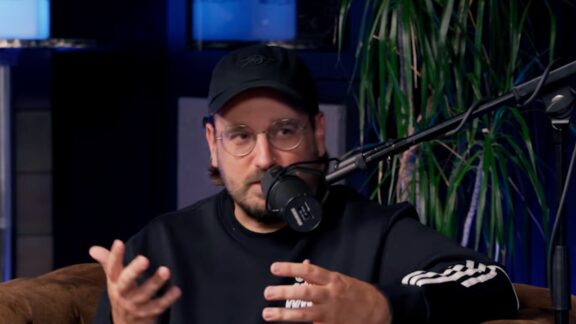

Season 1 · Episode 2
Former operations manager for an aerospace company who burned the candle at both ends building Basic Records while his first two daughters were born. Co-founded Hold Tight PR in the basement of Garlic & Shots in Soho. Ran TuneCore UK and changed how it felt. Signed Sleep Token when nobody had heard anything quite like them. Now Head of A&R at Spinefarm and Nuclear Blast - the biggest rock and metal label on the planet. Sat on Metallica's stage watching them set up. That kid with the broken arm listening to And Justice For All on cassette would not believe it.
Nathan Phillips grew up with a dad who played guitar and a stepdad who worked part-time for a hi-fi company, which meant Saturday mornings in a demo room in Radlett listening to Stevie Wonder's Songs in the Key of Life on equipment most people couldn't afford. His first records - bought with birthday money in WHSmith for a second-hand turntable his stepdad set up in his bedroom - were Michael Jackson's Thriller and a Paul McCartney compilation. His first metal record was Iron Maiden's Somewhere in Time, received on his twelfth birthday. Weeks later, off school with a broken arm from a skateboarding accident, a friend lent him a tape box containing And Justice For All by Metallica. That cassette started a lifelong obsession.
He played in a band called Method of Groove, produced electronic music for Global Underground and Ministry of Sound between 2000 and 2005, and in 2004 spotted a crop of genuinely exciting local bands, including the early lineup that would become Enter Shikari and the members who went on to form Tesseract and Monuments, around the Milton Keynes scene.
He built Basick Records around them in 2005, doing so while working his day job as an operations manager for an aerospace company, with his first daughter born in 2004 and his second in 2006. He did not give up the day job until 2007 or 2008. In January 2010 he co-founded Hold Tight PR with James Monteith in the basement of Garlic & Shots in Soho. He then ran TuneCore UK for two or three years, transforming how it was positioned in the market. He now serves as Head of A&R at Spinefarm and Nuclear Blast - Believe's specialist rock and metal labels - where he signed Sleep Token in their early days. He also works with Sharptone Records, whose artist Boston Manor held a pitch-black album playback in the Soho Hotel the night before this episode was recorded.
Duration: 72 minutes 27 Seconds
Season: 1 · Episode 2
Also available: Audio only on Spotify, Apple Podcasts and Acast
The demo room in Radlett, a broken arm and And Justice For All
Nathan Phillips' relationship with music begins with two specific physical memories: the smell of the hi-fi demo room in Radlett where his stepdad used to take him on Saturday mornings, and the experience of lying in bed with a broken arm from a skateboarding accident, listening to And Justice For All by Metallica on a friend's borrowed cassette. The demo room is where he first heard Stevie Wonder's Songs in the Key of Life, and he says that when he hears that record today he goes straight back to the smell of the room. Those two memories, one of music as physical, sensory experience, one of music as total immersion, have defined everything about how he thinks about artists, records and the job of A&R. He came to the recording the night after a pitch-black album playback for Boston Manor at the Soho Hotel, blindfolds, 50 fans, the whole album front to back in the dark, and describes it as a direct line from that demo room in Radlett.
Basick Records, the aerospace day job and Enter Shikari
The most instructive part of Nathan's origin story for any artist listening is the gap between ambition and security. He found the bands that would become Enter Shikari, Tesseract and Monuments playing the local Milton Keynes scene around 2004. He knew he wanted to build something around them. He also had a mortgage, two children under two, a wife and a day job as an operations manager for an aerospace company. He did not give up the day job until 2007 or 2008. He built Basic Records on the side, burning the candle at both ends for years, went to his bank manager with everything he could put together and started the label. The first two releases were compilation records designed to showcase the best of a UK scene that was finding its audience online through Pure Volume and MySpace. He also co-founded Hold Tight PR with James Monteith - formed in January 2010 in the basement of Garlic & Shots in Soho - having identified a gap in the market for rock and metal PR at a moment when that scene was genuinely breaking into the mainstream.
TuneCore UK, Spinefarm, Nuclear Blast and signing Sleep Token
Mark describes watching Nathan transform TuneCore UK from a service he barely knew about into something with genuine brand presence - pamphlets on release strategy handed out at BBC Introducing events, a clear sense of what the platform was for and who it served. Nathan is modest about it but clear: his job was to create awareness, to speak in terms artists actually understood and to be honest about what the platform was not for as well as what it was. From there he moved to Spinefarm and Nuclear Blast, where he signed Sleep Token in the very early days. What stood out was not the image or the anonymity concept - it was a voice with an immediately pop tone writing and constructing songs in a way that was instantly relatable for a very wide audience while simultaneously frankensteining a crushing metal sound into the middle of them. The first showcase was at UK Techfest. Managing the logistics of keeping the band anonymous while performing live was genuinely difficult. But the music was the thing. "Most bands in our scene look like me and you," he says. Sleep Token looked, and sounded, like nothing else.
On record labels, AI, streaming numbers and the value of music
Nathan's view on whether artists need a record label is shaped by having sat on every side: he founded his own label, ran a distribution platform and now heads A&R at the biggest rock and metal label on the planet. His answer is never a simple yes or no, it depends on where you are as an artist and what you need. Most artists need a team. A label is one way to get those functions. If you can source them independently and still have access to investment, you may not need a label at all. On AI, he draws the comparison to the first drum machine, a tool, not a replacement. People will always choose what feels real. On the one thing he would change about the industry: the value placed on music when new technologies arrived. The race to the bottom on pricing, Amazon pricing albums at a dollar during the download era, the eventual calculation of a Spotify stream, set up every royalty argument the industry has today. The film industry had more foresight. He also agrees completely with Mark's long-held view that streaming numbers should be removed from public display entirely. An arbitrary number does not tell you whether a song is any good. Comparing your 200 streams to someone else's 100 billion creates a competition that serves no one.
"I can remember the smell of the demo room I was sitting in. I hear that Stevie Wonder record and I go straight back there. That's what music does to you."
Nathan Phillips - Head of A&R at Spinefarm & Nuclear Blast
"That kid sitting on his bed with a broken arm listening to And Justice For All on cassette would never believe he'd be standing on Metallica's stage watching them set up."
Nathan Phillips - on his most life-affirming moment in music
"Never put your own success above the success of the artist you work for. That's the rudder that's always with me."
Nathan Phillips - the single best piece of advice he has received in his career
The Blinding Talent Music Industry Podcast is hosted by Mark Adams - founder of Blinding Talent and former Director of Music Programming at Channel 4, where he launched the Official YouTube Chart (2015) and Spotify's first ever Streaming Chart (2016). Each episode is an in-depth conversation with a senior music industry figure - equal parts campfire stories and practical insight.
f this episode resonated, Blinding Talent works with independent artists across the UK and internationally - helping them build the kind of artist identity, audience and commercial foundation that makes conversations with A&R figures like Nathan Phillips possible.
From artist management with Mark Adams to digital marketing campaigns across Spotify, Meta and YouTube, everything we do is built around getting artists closer to the music industry.
Nathan Phillips is Head of A&R at Spinefarm and Nuclear Blast - Believe's specialist rock and metal labels and among the most respected in the world for those genres. He began his career founding Basick Records in 2005 while working as an operations manager for an aerospace company, building the label around early Enter Shikari and the bands who went on to form Tesseract and Monuments. He co-founded Hold Tight PR with James Monteith in January 2010, ran TuneCore UK for two or three years, transforming how the platform was perceived in the UK - and signed Sleep Token to Spinefarm in their early days. He also works with Sharptone Records.
Nathan Phillips signed Sleep Token to Spinefarm in the very early days of the project. What stood out was not the anonymity concept or the image, it was a voice with a pop tone writing and constructing songs in a way that felt instantly relatable to a very wide audience while frankensteining a crushing metal sound into the centre of the music. Their first showcase was at UK Techfest. Managing the logistics of maintaining the band's anonymity while performing live was genuinely difficult. But the music was the thing, and Nathan says that finding something truly original, where there is no one else doing what that artist is doing, happens for him maybe once every few years.
Nathan Phillips has a unique perspective on this question, he has run his own record label, run a distribution platform (TuneCore UK) and now heads A&R at one of the biggest labels in rock and metal. His answer is never simply yes or no. It depends on where you are as an artist and what you need. Most artists need a team, and a label provides management support, marketing, PR, product strategy and investment. But those functions can also be sourced independently. The question is whether you need the investment and whether a label is the right source for it. Artists who approach A&R expecting a deal to solve all their problems are almost always disappointed, the label is a partner, not a solution.
The Blinding Talent Music Industry Podcast is hosted by Mark Adams - founder of Blinding Talent and former Director of Music Programming at Channel 4. Guests include Nathan Phillips, Colin Barlow, Sol Parker, Judd Lander and many others from across the music industry.