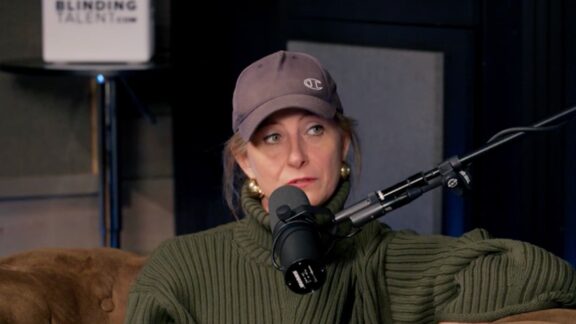

Season 1 · Episode 4
20 years at the heart of the recorded music industry. Head of Press at Matador Records. Director of International at Beggars Group for 13 years - working with Adele from her very first showcase. Head of TuneCore UK, Australia and Canada. The first person in the UK to write about Yeah Yeah Yeahs. Started with a fanzine called Froth that John Peel called out on his radio show.
Sarah Wilson grew up in South Essex and discovered music as a blessed relief during Britpop in the mid-90s - Suede, Delicatessen, Placebo and later Björk opening her eyes to a whole world of cross-genre creativity. Hungry to write and build community around music, she started a fanzine called Froth, which led to being called out on John Peel's radio show.
She moved to London to study Journalism at City University, worked with The Face on their annual drug survey, became the first person in the UK to write about Yeah Yeah Yeahs, and took a maternity cover at Time Out's music section that embedded her in the London music scene for a year. From there she moved to Matador Records as Head of Press, working with artists including Interpol and Cat Power, before joining the Beggars Group, where she spent 13 years in their international department, eventually as Director of International, working with artists including Adele from the beginning, The National, Radiohead, Queens of the Stone Age and hundreds more. After the department was dissolved she moved to Artist Services at The Orchard and then International at Universal before taking on the role of running TuneCore for the UK, Australia and Canada.
At TuneCore she has launched the SPLITS feature, allowing artists to prescribe royalty splits between collaborators at the point of upload - and Unlimited Pricing, allowing unlimited releases for one annual fee. TuneCore also runs an annual survey called Be The Change, examining the issues still facing women across the music industry.
Duration: 68 minutes 22 Seconds
Season: 1 · Episode 4
Also available: Audio only on Spotify, Apple Podcasts and Acast
The Evening Session, City University and the first UK piece on Yeah Yeah Yeahs
Sarah Wilson became music-obsessed at thirteen thanks to The Evening Session on Radio 1 - "thank you very much, Jo and Steve" - and followed that obsession into journalism, training at City University in London. The industry connections there were extraordinary: at the end of year one, the culture editor of The Face came in asking if any students wanted to help with their annual drug survey. Sarah spent a weekend in Hoxton with a clipboard asking people what drugs they took. From that, she started writing music pieces for The Face, and found, only recently, that she was the first person in the UK to write about Yeah Yeah Yeahs. She then took a maternity cover at Time Out's music section. Her heart told her to take it even though she was in the middle of her degree. It was the perfect mix of the two things she loved. A year embedded in the London music scene, writing about so many of her favourite artists. She describes it as invaluable. It has been twenty years since she entered the industry.
Adele, the XL showcase and Jonathan Dickens thanking her by name
The clearest through-line in this conversation is Adele - not as a name to drop but as a relationship that began before anyone could have predicted what it would become. Sarah was at the XL showcase where Simon Amstell was hosting, Jack Peñate was headlining and the bill also featured Laura Marling and Florence and the Machine. Adele played to maybe twenty or thirty people on a Sunday afternoon with an acoustic guitar in a tiny venue opposite the Barfly. "Her first line was, right everyone, you alright?" Sarah says. She was there across the first three albums as the Beggars Group's Director of International. At an industry award ceremony, Adele's manager Jonathan Dickens thanked her by name from the stage - and said the international success would not have been what it was without her. "I felt like every pair of eyes in the room was on me," she says, "which it wasn't - no one knew who I was. But I just went, oh my God, it's been recognised." She also remembers the photograph of Adele stepping off a plane at LAX with her baby, looking vulnerable and terrified, and the intrusion it represented - and how differently she felt about it once she became a mother herself.
The National in Berlin, BTS fandom and being thanked for work behind the scenes
A week in Berlin with The National for the High Violet press campaign, journalists flying in from around the world, interviews every day, ended with a performance in the hotel courtyard for around 250 people. Halfway through the set, Sarah had one of the clearest pinch-me moments of her career: she was in Berlin watching The National play High Violet and this was her job. The conversation then moves into fandom, specifically BTS, whose fans she describes as absolutely phenomenal and rather terrifying in their organisation. Driving through Vauxhall one day, she looked up at an out-of-home billboard for BTS and assumed her team had placed it. They had not. The fans had clubbed together to pay for a birthday billboard for each of the members. She uses this as the example of what the industry means when it calls for super fans, and also as a prompt to think about where the boundaries are between the artist, the industry and the fan. The industry has a responsibility to make sure that advocacy does not come at the cost of the artist's wellbeing.
TuneCore, streaming fraud, removing visible stream counts and the next 10 years
The TuneCore section of this conversation is specific and grounded. Sarah describes how the platform has evolved - built on a belief in independence and artist ownership, now home to artists including Rosie Murphy, Joss Stone, Cleo Sol, Nine Inch Nails, Sonic Youth, Chance the Rapper and Russ, alongside Jack Peñate, who she notes with amusement still uses TuneCore and is part of a small XL reunion on the platform. She is direct about streaming fraud: streaming farm bots are real, they funnel money into harmful places, and the industry has a responsibility to educate artists rather than let them be exploited by promises of streams. She is equally direct on visible stream counts. She thinks Spotify should remove them - and is surprised when Mark says he has been arguing the same thing for four years. If you remove the numbers, she reasons, you remove much of the incentive for gaming the system, and you free artists from an ego-driven metric that rarely reflects genuine fan relationships. Her view of the industry in ten years: more high-quality musicianship, AI as the dominant discussion, more music being released than ever - in one day in 2025 more music was released than in the entire year of 1989. But the heart will still beat. Music is language. It will not go away.
"I was the first person in the UK to write about Yeah Yeah Yeahs. From The Face on a clipboard in Hoxton to helping artists distribute music to the world - this industry never stops surprising you."
Sarah Wilson - TuneCore UK
"I've never met an artist who has that global resonance with people because she is just herself. That's Adele."
Sarah Wilson - on working with Adele from the beginning
"Distribution is not the same as marketing. Getting your music onto Spotify doesn't make anyone listen to it."
Sarah Wilson - on what independent artists consistently misunderstand
The Blinding Talent Music Industry Podcast is hosted by Mark Adams - founder of Blinding Talent and former Director of Music Programming at Channel 4, where he launched the Official YouTube Chart (2015) and Spotify's first ever Streaming Chart (2016). Each episode is an in-depth conversation with a senior music industry figure - equal parts campfire stories and practical insight.
If this episode resonated, Blinding Talent works with independent artists across the UK and internationally - providing exactly the kind of digital marketing expertise and strategic thinking that Sarah describes from two decades at the heart of the recorded music industry.
From artist management with Mark Adams to Spotify growth campaigns and Meta advertising, everything we do is built around helping artists build real, sustainable careers.
Sarah Wilson is the Head of TuneCore for the UK, Australia and Canada. She has spent 20 years at the heart of the recorded music industry, including as Head of Press at Matador Records (working with Interpol and Cat Power), Director of International at Beggars Group for 13 years (working with Adele from the beginning, The National, Radiohead and Queens of the Stone Age, among many others), and roles at The Orchard and Universal before joining TuneCore. She was the first person in the UK to write about Yeah Yeah Yeahs. She began her career with a fanzine called Froth that John Peel called out on his radio show.
Sarah Wilson spent 13 years at the Beggars Group in their international department, eventually as Director of International. In that role she worked with artists including Adele from the very beginning of her career - across the first three albums - as well as The National, Radiohead, Queens of the Stone Age and many more. She was present at Adele's first XL showcase, which she describes as one of the clearest memories of her career: Adele walking out with an acoustic guitar, in a floral dress, playing to twenty or thirty people on a Sunday afternoon on a bill with Laura Marling, Florence and the Machine and Jack Peñate.
Sarah Wilson believes Spotify should remove publicly visible stream counts. She argues that streaming numbers are an ego-driven metric that rarely reflects genuine fan relationships, and that their visibility is a significant driver of the streaming fraud problem, if artists cannot see the numbers publicly, much of the incentive for gaming the system disappears. She was surprised to find that Mark Adams had been making the same argument for four years. She also believes that artists - especially those starting out - are better served by focusing on genuine audience-building than chasing streaming metrics that do not reliably convert to live audiences or sustainable income.
The Blinding Talent Music Industry Podcast is hosted by Mark Adams - founder of Blinding Talent and former Director of Music Programming at Channel 4. Guests include Sarah Wilson, Colin Barlow, Sol Parker, Judd Lander and many others from across the music industry.